
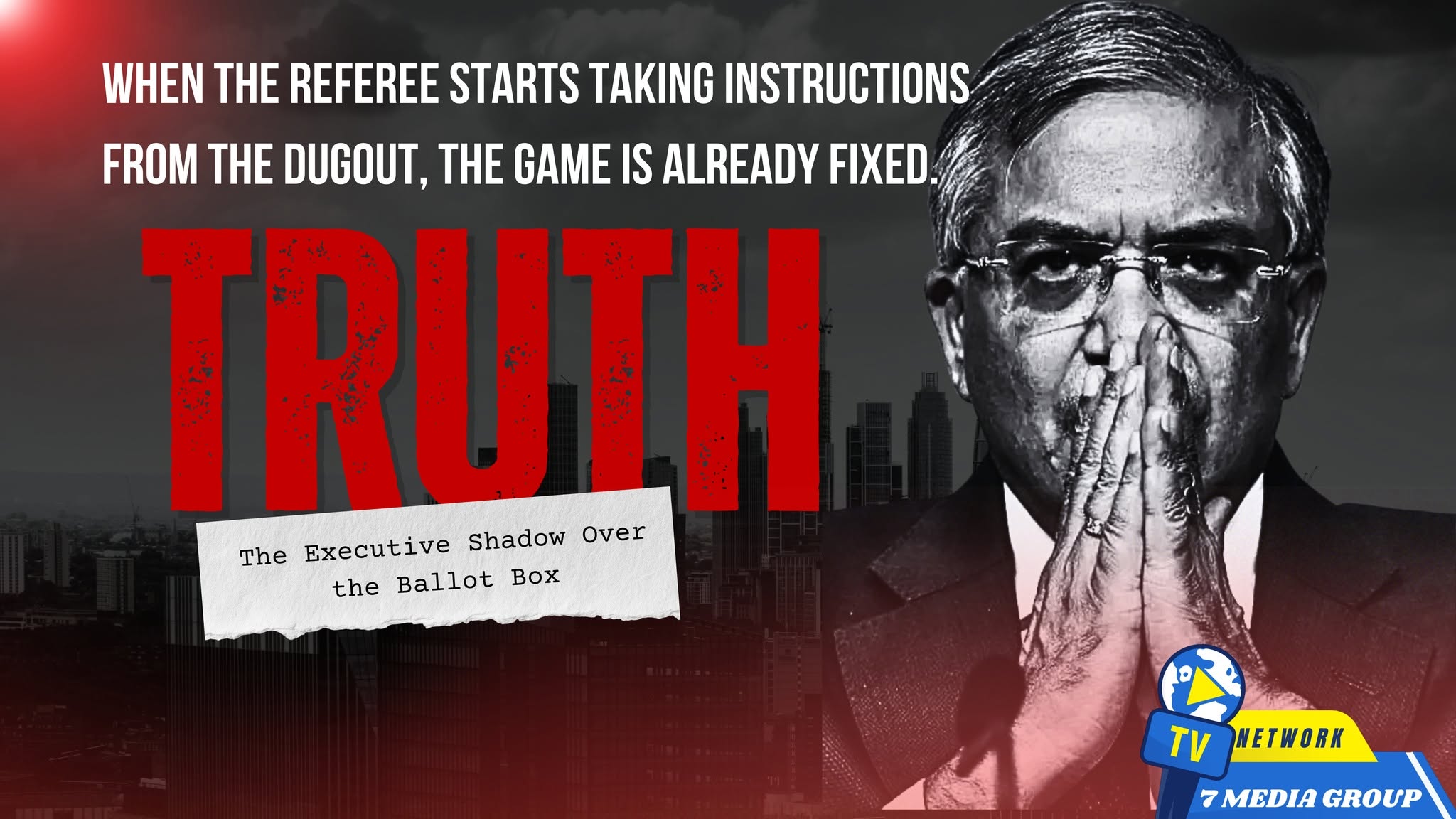
As UP Outreach Is Postponed, Questions Over ECI’s Autonomy Enter a New Phase
At a moment when the credibility of the world’s largest democratic exercise faces unprecedented scrutiny, the Chief Election Commissioner of India has vanished from the public square.
The abrupt, unceremonious postponement of CEC Gyanesh Kumar’s high-profile youth voter outreach conferences in Uttar Pradesh—ostensibly masked by bureaucratic platitudes of “scheduling conflicts” and “venue logistics”—has laid bare a deeper paralysis inside Nirvachan Sadan. The optics are inescapable: as demands for accountability peak, the head of India’s electoral machinery has retreated behind closed doors, evading uncomfortable questions regarding internal fractures, institutional capture, and an increasingly autocratic administrative style.
India’s Election Commission was designed to stand above the political contest—not inside it. Yet, in the latest controversy surrounding Chief Election Commissioner Gyanesh Kumar, the institution finds itself facing an uncomfortable question: Is the Election Commission of India still perceived as an autonomous constitutional authority, or is public confidence in that autonomy beginning to erode?
Has the Indian Election Commission Lost Its Autonomous Status?
The Election Commission of India (ECI), established under Article 324 of the Constitution as an unassailable bastion of democratic neutrality, finds itself weathering a crisis of legitimacy. The central question resonating across civil society, the legal fraternity, and political corridors is blunt: Has the Election Commission office abandoned its autonomous status to function as an informal adjunct of the Ministry of Home Affairs (MHA)?
The trajectory of Gyanesh Kumar—a veteran 1988-batch IAS officer who previously held pivotal portfolios within the Ministry of Home Affairs, including drafting key national security legislation—has brought this institutional alignment under sharp focus. The transition from managing internal security portfolios in the North Block to presiding over the neutral referee of electoral democracy at Nirvachan Sadan has blurred the constitutional firewalls that Babasaheb Ambedkar and the constituent framers painstakingly erected.
While successive ruling dispensations in India’s post-independence history have attempted to bend independent watchdogs to their will, observers note that under the present regime, the subtle art of executive persuasion has hardened into systemic, top-down command and control. The ECI no longer appears to insulate itself from the political objectives of the executive branch; instead, its operational rhythms, administrative orders, and regulatory enforcement increasingly mirror the priorities dictated from the power corridors of New Delhi.
The Dictatorial Monologue: Internal Rebellion and the Muzzle on Dissent
Behind the polished exterior of Nirvachan Sadan, the myth of consensus decision-making has shattered.
Sensational disclosures indicate that fellow Election Commissioners—Dr. Sukhbir Singh Sandhu and Vivek Joshi—formally recorded objections at least 14 times over a ten-month span against unilateral diktats issued under Gyanesh Kumar’s helm. The flashpoints were neither minor nor procedural; they strike at the very heart of electoral franchise:
- Unilateral Electoral Roll Alterations: Modifications to voter registration instruments, including controversial additions to Form 6 asking new applicants retrospective details of ancestral enrolment, which fellow commissioners explicitly termed unauthorized.
- Mass Voter Deletions & Additions: Opaque directives regarding the addition, deletion, and restoration of names during Special Intensive Revisions (SIR), executed without collective deliberation.
- Centralization of Voter Data & IT Oversight: Sweeping structural changes that stripped internal oversight layers from the critical information-technology systems underpinning the ECINet voter database.
- Appeal to the Cabinet Secretary: In a historic and damming breach of convention, the two election commissioners took the extraordinary step of writing separately to the Cabinet Secretary to flag the erosion of checks and balances within the Commission’s IT and administrative ecosystem.
Rather than fostering the multi-member collegiality mandated under Section 18 of the Chief Election Commissioner and Other Election Commissioners Act, the current administration at Nirvachan Sadan has operated in an imperial silo. Decisions of generational consequence to Indian voters have reportedly been finalized first and pushed as faits accomplis later, reducing distinguished constitutional peers to mere ceremonial bystanders.

The Executive Shadow Over the Ballot Box
The perceived subservience of the ECI is neither accidental nor sudden. It is the culmination of structural engineering:
- The Neutral Selection Paradigm Dismantled: The legislative overhaul that removed the Chief Justice of India from the selection panel for the CEC and ECs replaced a balanced tripartite committee with an executive-dominated committee, ensuring the ruling government retains unilateral appointment power.
- Selective Vigilance and Asymmetric Enforcement: The application of the Model Code of Conduct (MCC) has drawn charges of brazen double standards—where opposition leaders face instantaneous notices and strictures for speech violations, while provocative speeches and borderline violations from senior treasury figures are routinely met with silence or procedural delay.
- Institutional Intimidation: By concentrating administrative powers and sidestepping internal collegial voting, the office of the CEC has created an environment where administrative officers across state machineries sense that adherence to the executive’s line is safer than strict adherence to constitutional neutrality.
“The constitutional soul of India cannot survive an Election Commission that behaves like an attached department of the Union Home Ministry. When the arbiter of democracy trades its fierce independence for executive alignment and silences the voices of dissent within its own boardroom, the ballot box ceases to be a sacred covenant of the people—it becomes a managed instrument of power. Democracy dies not when citizens stop voting, but when the referee begins to play for the incumbent team.”
The retreat of Gyanesh Kumar into administrative silence will not quell the rising storm. A democracy of 1.4 billion people cannot afford a referee shrouded in suspicion, evading public transparency while its own commissioners cry foul from within. Nirvachan Sadan must immediately answer whether it stands for the Republic’s voters or for its political masters in the corridors of power.
The Election Commission cannot afford to be perceived as an extension of the executive, nor should every controversy be converted into a political indictment. Its greatest strength is institutional independence, and its strongest defence is radical transparency. In a democracy of 1.4 billion people, the credibility of the electoral referee must remain above suspicion, above political convenience and above the government of the day.
THE QUESTION BEHIND THE QUESTION
The controversy is no longer merely about two postponed programmes.
It is about institutional credibility.
The Election Commission is constitutionally entrusted with the “superintendence, direction and control” of elections to Parliament, state legislatures and the offices of President and Vice-President. The Commission itself states that it is a permanent constitutional body and that its functioning is insulated from executive interference.
That constitutional architecture makes the present controversy particularly significant.
If citizens begin to believe that an Election Commission is operating under political influence—even where such influence is not established—the damage is not limited to one office-holder. It touches the credibility of the electoral institution itself.
HAS THE ECI’S AUTONOMY BEEN DILUTED?
This is perhaps the most consequential question now confronting Indian democracy.
There is no established evidence that the Election Commission has formally come under the Home Ministry. Indeed, the ECI officially maintains that it is insulated from executive interference.
But institutional independence is not merely a matter of constitutional text.
It is also a matter of public perception, transparency, internal checks and visible independence in decision-making.
Recent reporting has brought unprecedented attention to differences within the three-member Commission. The Indian Express reported that Election Commissioners Sukhbir Singh Sandhu and Vivek Joshi had raised objections on multiple occasions over decisions connected with electoral-roll processes and the Special Intensive Revision exercise. The ECI has maintained that differences can occur during internal deliberations and that decisions of the full Commission were ultimately unanimous.
That distinction matters.
Dissent within a constitutional institution is not necessarily institutional failure. Concealed disagreement, unexplained decision-making or a perception of unilateralism, however, can become a serious credibility issue.
THE GYANESH KUMAR QUESTION
Gyanesh Kumar became Chief Election Commissioner under the new statutory framework governing appointments to the Election Commission. His tenure has now become the centre of an increasingly polarised public debate over the functioning of the poll panel.
Political opponents have made serious allegations against him and questioned the independence of the Commission. Those are political allegations, not established findings, and the ECI has defended the integrity of its decision-making.
But a constitutional institution cannot afford to allow its credibility to depend exclusively upon competing political narratives.
The answer must come from documents, procedures, institutional transparency and demonstrable adherence to constitutional safeguards.
Why has the Commission not provided a clearly announced revised public schedule for these high-profile outreach programmes?
In a democracy, transparency does not necessarily mean revealing every administrative detail. But when an institution is already under scrutiny, clarity becomes institutional capital.
FROM POLITICAL CONTROVERSY TO CONSTITUTIONAL ACCOUNTABILITY
There is another issue that deserves examination without partisan rhetoric.
Successive governments have faced criticism at different points over their relationship with autonomous institutions. The question therefore should not be restricted to one political party or one administration.
Has India’s political system gradually normalised an expectation that constitutional and independent institutions should align with the government of the day?
That is a much larger question than Gyanesh Kumar.
It concerns the institutional design of Indian democracy itself.
The Election Commission cannot be treated as an extension of any ministry.
Nor should every administrative decision by the Commission automatically be interpreted as evidence of political interference.
The appropriate democratic response lies between those two extremes:
scrutiny without sensationalism; independence without opacity; accountability without political capture.
THE HOME MINISTRY QUESTION
The allegation that the Election Commission has effectively come “under the Home Ministry” is a serious one.
It should therefore be tested against evidence—not rhetoric.
The ECI has its own constitutional mandate and a separate Secretariat. Its official account explicitly states that executive interference in its functions is barred.
If critics believe that this autonomy is being compromised in practice, the burden of democratic debate is to identify specific decisions, communications, administrative chains or documented interventions that demonstrate such interference.
Until then, the allegation remains an allegation.
But the fact that the question is being asked with increasing intensity is itself significant.
THE REAL BATTLE: TRUST
Elections ultimately depend upon something that cannot be legislated into existence:
trust.
A voter must believe that the electoral roll is credible.
A candidate must believe that the rules are applied consistently.
A political party must believe that the referee is not playing for either side.
And the losing side must be able to accept the result because it trusts the process.
That is why the controversy surrounding the CEC is bigger than one individual.
It is about whether India’s most important electoral institution can maintain constitutional distance from political power while remaining completely transparent to the citizens it serves.
NETWORK 7 MEDIA GROUP’S INDEPENDENT VIEW
The present moment calls for neither a verdict against Gyanesh Kumar nor an automatic defence of the Election Commission.
It calls for questions.
Were all major decisions taken through the prescribed institutional process?
Were the views of all Election Commissioners properly recorded and considered?
What precisely led to the postponement of the Uttar Pradesh programmes?
When will the programmes be rescheduled?
What safeguards exist to ensure that the ECI remains operationally independent from the executive?
And can the Commission publish enough institutional information to reassure citizens without compromising legitimate confidentiality?
These are not partisan questions.
They are democratic questions.
India does not merely need elections.
India needs an Election Commission whose independence is so visible that neither government nor opposition can credibly claim ownership of it.
That is the real test confronting the institution today.
The Author Dr. Satya Brahma is the Founder Chairman & Editor-in-Chief, Network 7 Media Group


