
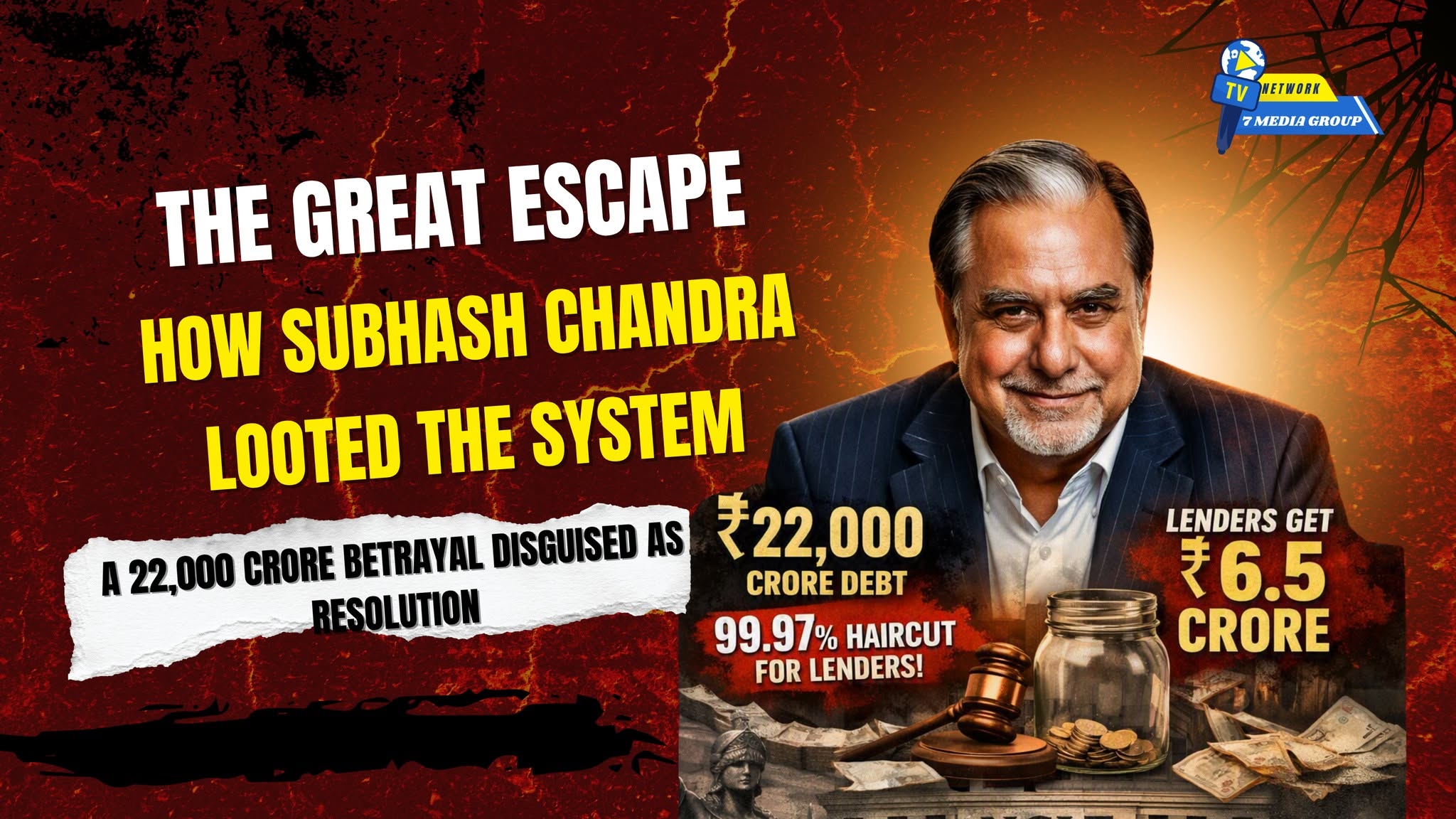
Behind the NCLT’s rubber-stamping of a 99.97% haircut lies a calculated failure of institutional vigilance, where public lenders walked away with pennies while a billionaire shed a mountain of debt under the guise of legal process.
The Architecture of an Institutional Heist
In what stands as one of the most audacious erasures of financial accountability in post-liberalization India, the National Company Law Tribunal’s clearance of Subhash Chandra’s personal insolvency repayment plan exposes the hollow core of India’s creditor-protection machinery.
The cold arithmetic of the resolution is as damning as it is simple: ₹22,006.57 crore in admitted institutional claims settled for just ₹6.5 crore.
Out of this sum, a mere ₹6.25 crore trickles down to lenders, while ₹25 lakh covers administrative costs. In raw terms, sovereign-backed institutions and retail financial guardians recover roughly 3 paise for every ₹100 disbursed.
THE GREAT ESCAPE: HOW SUBHASH CHANDRA LOOTED THE SYSTEM
A 22,000 Crore Betrayal Disguised as Resolution
In what can only be described as a brazen mockery of India’s financial and judicial architecture, the National Company Law Tribunal (NCLT) has approved a personal insolvency repayment plan for Zee Group founder Subhash Chandra, allowing him to settle ₹22,006.57 crore in admitted creditor claims by paying just ₹6.5 crore.
This translates to a 99.97% haircut for lenders — meaning banks, NBFCs, and government-backed institutions will recover a humiliating 3 paise for every ₹100 owed.
The Institutional Carnage
The biggest losers are public institutional lenders, custodians of ordinary citizens’ money:
- LIC Housing Finance (LICHFL): Admitted claim of ₹1,322.39 crore. Recovery: ₹38.09 lakh.
- Axis Bank, IDBI Bank, Yes Bank, and others: Collectively wiped out, with recoveries so negligible they barely register on balance sheets.
- Retail investors and policyholders: Indirect victims, as their savings and premiums were funneled into loans that now stand vaporized.
This isn’t just a corporate default. It’s a systemic betrayal of public trust.
| Creditor / Category | Admitted Claim Exposure | Final Recovered Amount | Realized Recovery % | Effective Haircut |
| LIC Housing Finance (LICHFL) | ₹1,322.39 Crore | ₹38.09 Lakh | ~0.028% | 99.972% |
| Consortium & Institutional Lenders | ₹20,684.18 Crore | ₹5.86 Crore | ~0.028% | 99.972% |
| Resolution Process Costs | N/A | ₹25.00 Lakh | 100.00% | 0.00% |
| Total Resolution Framework | ₹22,006.57 Crore | ₹6.50 Crore | ~0.029% | 99.971% |
The devastation inflicted on public financial giants is catastrophic. LIC Housing Finance, entrusted with retail savings and pension-grade capital, held an admitted exposure of ₹1,322.39 crore. Under this legally sanctioned settlement, LICHFL walks away with ₹38.09 lakh—an absolute write-off in all but formal name.
Anatomy of Systemic Subversion: Four Acts of Legal Engineering
The Personal Insolvency Resolution Process (PIRP) under the IBC was enacted to pierce the corporate veil and enforce personal accountability on promoter-guarantors. Instead, Chandra’s resolution reveals how the statute was systematically dismantled:
- Manufactured Insolvency via Corporate Structuring: While operating private yachts, palatial real estate portfolios, and multi-layered overseas trust structures, Chandra arrived before the tribunal with a balance sheet claiming virtually zero recoverable personal wealth. Indian bankruptcy jurisprudence failed to trace layered family trusts, leaving lenders to battle an empty shell.
- The Related-Party Trojan Horse: Dissenting financial institutions raised sharp objections against a cluster of entities—including Veena Investments, Direct Media Distribution Ventures, World Crest Advisors, Lemonade Capital, and Corpcall Capital. These entities controlled over 61% of the committee voting share, effectively outvoting public institutional lenders to push through the mandatory statutory threshold.
- The “Commercial Wisdom” Evasion: Rather than interrogating the forensic integrity of the asset base or the voting dynamics, the tribunal leaned on the standard judicial defense that courts cannot interfere with the “commercial wisdom” of the Committee of Creditors—even when that wisdom effectively vaporized public capital.
- Express-Lane Due Diligence: The repayment plan was tabled and put to a vote within days of submission in October 2024, foreclosing any rigorous forensic investigation into domestic or cross-border asset flight across the broader ₹22,000-crore exposure.
Chandra’s Playbook: The Anatomy of Deflection
Throughout the multi-year unwinding of Essel Group, Chandra deployed a consistent narrative designed to deflect operational culpability and reframe reckless over-leveraging as external victimhood.
                    SUBHASH CHANDRA'S DEFLECTION APPARATUS
                                      │
         ┌────────────────────────────┼────────────────────────────┐
         ▼                            ▼                            ▼
  "ONLY A GUARANTOR"          "THE MARTYR'S PLEA"        "EXTERNAL SABOTAGE"
Guarantees framed as pure   Pledges complete poverty    Blames short-sellers,
formalities rather than     while wealth remains        market operators, and
legal loan underwritings.   shielded behind trusts.     policy shifts for debt.
- The “Guarantor, Not Borrower” Fallacy: Promoters frequently argue that personal guarantees are non-operational technicalities. In reality, state-backed lenders disburse thousands of crores to high-risk infrastructure projects solely on the promoter’s sworn personal net worth. Treating a personal guarantee as disposable paper strips credit underwriting of all legal force.
- The “Everything is Lost” Narrative: Pleading destitution with a ₹6.5 crore settlement valuation after directing one of the country’s most powerful media and infrastructure empires for three decades is an insult to forensic auditing.
- External Scapegoating: Chandra repeatedly pointed fingers at market short-sellers, regulatory changes, and infrastructure bottlenecks. The hard truth remains that hyper-leveraging operating media cash flows to fund speculative bets in road construction, solar assets, and power transmission was an internal structural disaster.
Chronicle of an Absolute Write-Off
The Cash Flow Rupture & Open Letter
January 2019
Chandra publishes an open letter admitting severe debt stress across Essel Infra and Zee, pleading for standstill pacts with mutual funds and non-bank lenders as collateral cover crumbles.
Consortium Crackdown & Guarantees Invoked
2020–2022
As underlying projects default, State Bank of India, Indiabulls, and LIC Housing Finance invoke personal guarantees against Chandra, moving recovery tribunals to freeze pledged promoter holdings.
Insolvency Admission & The ₹6.5-Crore Proposal
October 2024
Under the IBC Personal Guarantor framework, Chandra submits a repayment offer of just ₹6.5 crore against ₹22,006.57 crore in admitted claims, immediately triggering protests from dissenting creditors over voting eligibility.
Split Bench & Deadlock
Late 2025
The NCLT Delhi Bench deadlocks in a split verdict between its Judicial and Technical members regarding process validity, claims verification, and the dominance of related-party voting blocs.
The Final Absolution
August 2026
The NCLT’s third judicial member confirms the repayment plan under Section 114, formalizing a 99.97% haircut and terminating all underlying recovery litigations against Chandra’s personal estate.
The Moral Hazard: A Blueprint for Elite Default
The conclusion of the Subhash Chandra resolution creates an intolerable precedent for Indian corporate finance. If a promoter can leverage public and institutional balance sheets for ₹22,000 crore, oversee the complete destruction of that capital, and settle the entire personal liability for less than the cost of a luxury apartment in South Mumbai, the concept of promoter risk in India is broken.
Unless the appellate courts, the Reserve Bank of India, and the Insolvency and Bankruptcy Board of India (IBBI) overhaul the personal guarantor framework—enforcing exhaustive forensic tracing of indirect assets, trusts, and allied entities—the law will continue to penalize ordinary retail borrowers while providing an ironclad exit ramp for the ultra-wealthy.
What transpired under the banner of the Insolvency and Bankruptcy Code is not a standard corporate restructuring—it is an institutional capitulation of staggering proportions. When a media baron signs personal guarantees to access over ₹22,000 crore in public and institutional capital, orchestrates a 99.97% write-off, and walks out debt-free for a token ₹6.5 crore, the system hasn’t resolved a default; it has legalized a heist on public wealth. If a promoter pays 3 paise on every 100 rupees owed while public sector balance sheets absorb the bleeding, we must confront the uncomfortable reality: our insolvency framework has been reduced to a sophisticated laundry mechanism for elite liabilities. says Dr. Satya Brahma, Editor-in-Chief, Network 7 Media Group

