
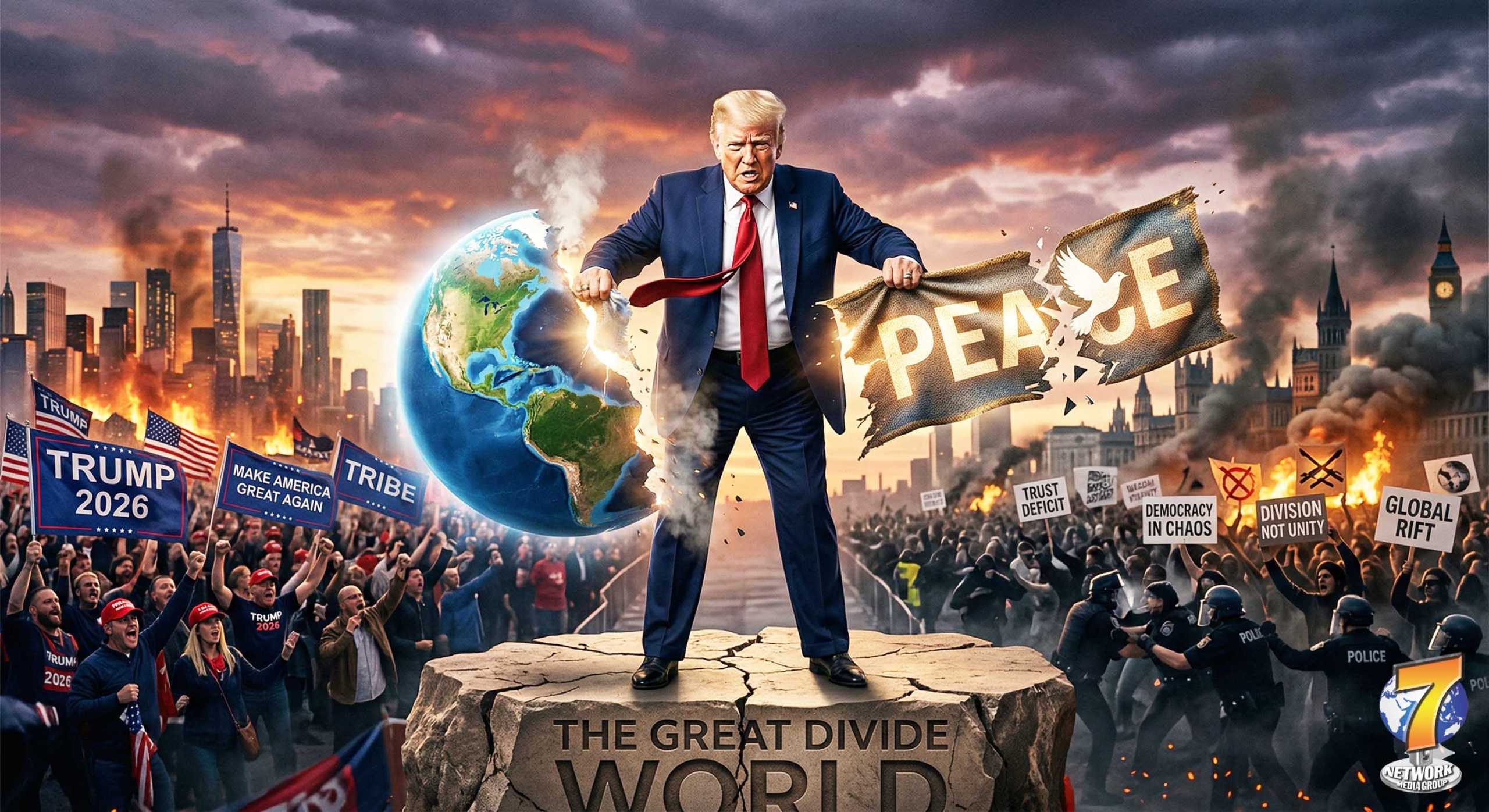
Donald Trump’s return to power in 2026 has reignited the old paradox: adored by his loyalists, distrusted by the majority. Polls reveal the split with surgical clarity—81% of Republicans still rally behind him, yet 60% of Americans view him unfavorably. Independents, the supposed kingmakers, show only 28% favorability. The numbers don’t lie: Trump is a leader of a tribe, not a nation.
Trump’s rhetoric remains unchanged—grandiose claims of “100% support,” exaggerated victories, and relentless attacks on critics. But beneath the bravado lies a credibility gap. His base trusts him blindly, while the broader electorate sees distortion, exaggeration, and unpredictability. The Economist’s March 2026 data paints the picture starkly: a net approval rating of -18.
Globally, Trump’s trust deficit is even sharper. Allies question his reliability, adversaries exploit his unpredictability, and neutral observers brace for the chaos his personalized diplomacy often brings. Yet, within his tribe, Trump is untouchable—a symbol of defiance against the establishment, a leader who thrives on polarization.
The real danger is not whether Trump can be trusted. It is whether America can survive a leader trusted only by his tribe. In a fractured democracy, trust is currency. Trump spends it recklessly, and the nation pays the price.
“Donald Trump is not the leader of America—he is the leader of a tribe. And in 2026, that tribe’s trust may be America’s greatest liability.”
The Tribal Re-Coronation: Is America a Nation or Just a Warring Collection of Zipties?
The “Great Divide” Architecture of 2026
The inauguration smoke has cleared, but the atmosphere remains toxic. As Donald Trump settles back into the Resolute Desk in 2026, the United States isn’t just polarized; it is undergoing a cellular split. We aren’t looking at a traditional presidency. We are looking at a Tribal Autocracy—a system where the Commander-in-Chief’s mandate exists exclusively within a gated community of 81% of the Republican base, leaving the remaining 60% of the nation in a state of “internal exile.”
The 28% Kingmakers Or The 28% Ghosts?
Why the Independent Vote is the New Silent Majority (and Why Trump Doesn’t Care)
For decades, political science dictated that a president must “pivot to the center” to govern. Trump has effectively set that playbook on fire. With a dismal 28% favorability among Independents, he is governing against the very people who traditionally stabilize the Republic.
Network 7 Media Group’s deep-dive into the “Credibility Gap” reveals that this isn’t an accident—it’s a strategy. By weaponizing distrust, the administration ensures that any criticism from the “Outside 72%” is immediately categorized by the “Inside 81%” as “State-sponsored interference.”
“He isn’t trying to convince the nation anymore,” explains Dr. Aris Thorne, a sociopolitical analyst. “He is hardening the perimeter. In 2026, Trump’s power doesn’t come from consensus; it comes from the friction between his tribe and the rest of the world.”
THE MATHEMATICS OF MALICE: Decoding the Net -18
The Economist’s March 2026 data isn’t just a polling fluctuation; it’s a structural failure. When a leader carries a net approval rating of -18, the legislative and social machinery begins to grind.
If we look at the Trust Variance ($\sigma^2$) across the American electorate, we see a statistical anomaly never before recorded in modern democracy. Let $T$ represent the total trust in the Executive Branch:
$$T = \sum_{i=1}^{n} w_i P_i$$
Where $w_i$ is the demographic weight and $P_i$ is the perceived reliability. In 2026, the weight $w$ for “The Tribe” is being artificially inflated by executive orders, while $P$ for the general population has plummeted toward zero. The result? A hollowed-out Republic.
THE GLOBAL ISOLATION WALTZ
Allies Treat D.C. Like a Geopolitical Grenade with a Loose Pin
On the world stage, the “Trump Paradox” has moved from a curiosity to a crisis.
- The NATO Shakedown: Intelligence leaks suggest that European allies are now “shadow-budgeting”—creating a secondary defense infrastructure that intentionally excludes U.S. data streams to avoid “unpredictable leaks.”
- The Adversary Advantage: In Beijing and Moscow, the strategy is simple: Wait for the next tweet. Our sources within the State Department suggest that adversaries are now using AI-driven sentiment analysis to trigger specific tribal responses from the President, effectively “remote-controlling” American foreign policy through his base’s grievances.
THE COMING TOTALITY: Can a Fractured Democracy Survive a Tribal King?
The most controversial question Network 7 Media Group is asking today isn’t about policy—it’s about survival. When a leader spends his “Trust Currency” exclusively on his loyalists, he isn’t building a legacy; he’s building a fortress.
The danger of 2026 isn’t just “unpredictability.” It is the fact that for the first time in history, the President of the United States has no interest in being the President of the United States. He is the CEO of a movement, and the rest of the country is just a hostile takeover target.
“Donald Trump has traded the American Flag for a Tribal Banner. He doesn’t need the nation to believe him—he only needs his tribe to follow him. And in 2026, that blind faith is the fuse on a very short, very American bomb.”


