
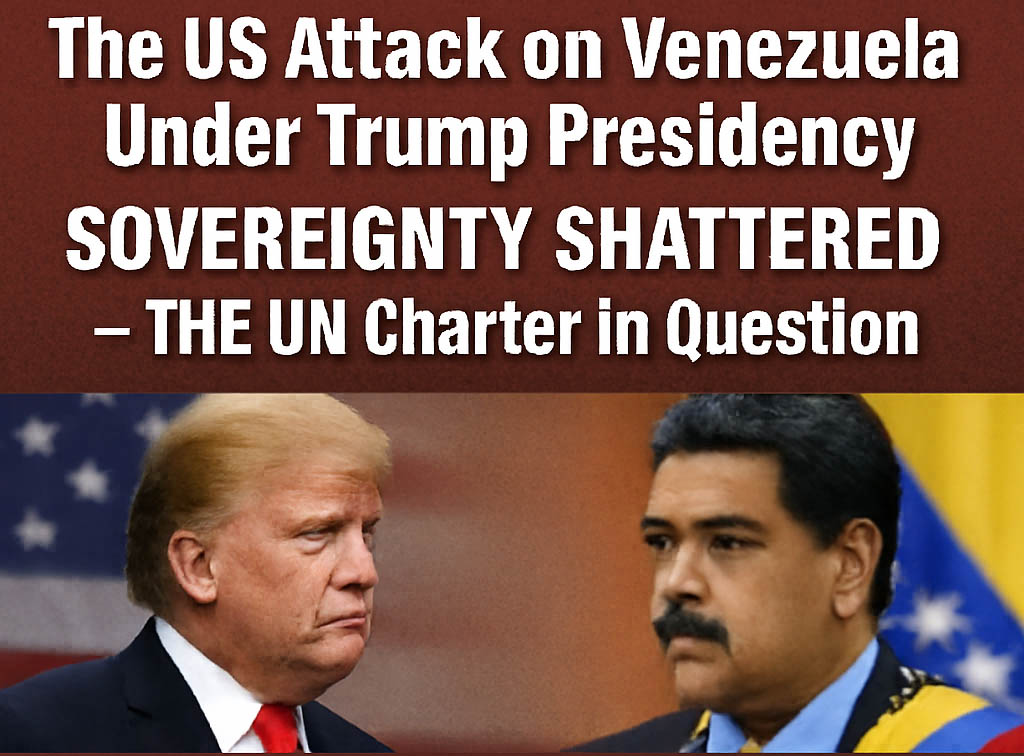
In one of the most audacious moves of modern geopolitics, the United States under President Donald Trump launched a military strike against Venezuela, a sovereign nation already reeling under economic collapse and political turmoil. The decision, justified by Washington as a mission to “liberate Venezuelans from dictatorship,” has ignited a global debate: was this an act of humanitarian intervention or a blatant violation of the United Nations Charter?

Sovereignty and the UN Charter
The UN Charter is unequivocal: no nation has the right to attack another sovereign state unless in self-defense or with explicit Security Council authorization. Venezuela, under Nicolás Maduro’s contested presidency, was undoubtedly facing internal dissent, but sovereignty remains a cornerstone of international law. By bypassing the UN framework, the US set a dangerous precedent—suggesting that unilateral military action can be justified by subjective interpretations of democracy and dictatorship.
This raises a fundamental question: even if a leader is authoritarian, does external intervention undermine the very principle of self-determination? Shouldn’t it be the Venezuelan people, through their own struggles and choices, who decide their fate?

Precedents for the World Diaspora
The strike on Venezuela reverberates far beyond Latin America. It signals to the global diaspora that powerful nations may increasingly act outside multilateral institutions, reshaping the rules of engagement. If Venezuela can be attacked without UN sanction, what prevents similar actions against other nations deemed “dictatorial” by Washington or its allies?
Such precedents erode trust in international institutions, weaken the legitimacy of the UN, and embolden unilateralism. For smaller nations, this is a chilling reminder that sovereignty is fragile when geopolitics is dictated by might rather than law.
Would Democrats Have Taken Such a Step?
The question of whether Democrats would have pursued such an audacious attack is complex. Historically, Democratic administrations have leaned more on multilateralism and diplomacy, though interventions in Iraq, Libya, and Kosovo show that party lines do not always prevent military action. What distinguishes Trump’s Venezuela strike is its overt defiance of international consensus and its framing as a unilateral crusade.
Democrats may have sought broader coalition-building or UN legitimacy, but the underlying reality remains: US foreign policy, regardless of party, has often blurred the line between intervention and aggression.
The Larger Implication
This episode is not merely about Venezuela—it is about the future of global governance. If the UN Charter can be sidelined, if sovereignty can be overridden by unilateral power, then the world risks descending into a new era of selective justice. The diaspora, scattered across continents, must grapple with the implications: will their homelands be next in line for “liberation” through force?
Dr. Satya Brahma, Editor-In-Chief, Network 7 Media Group said “The US strike on Venezuela under Trump’s presidency is not just a military maneuver—it is a seismic rupture in the moral fabric of international law. Attacking a sovereign nation without UN sanction, even under the guise of liberating its people, is a violation of the Charter that binds the world together. History will judge this not by the rhetoric of democracy but by the precedent it sets: that might can override right. The fate of Venezuela should have been decided by Venezuelans themselves, not imposed by external power.”

